
Singapore – Doctors recommend exercise for rehabilitation before surgery to manage chronic health conditions and help patients return to health.
But how to exercise when you are sick or face difficulties in physical activity?Here are three ways to deal with the situation.
For Fatima Megara Nathan Arokianathan, a research manager at a local university, exercise used to be a way of life. She regularly swam and did high-intensity workouts such as CrossFit.
“I had a passion for exercise,” says the 40-year-old.
In 2022, her life changed. One day I woke up and my foot was swollen to three times its normal size. She felt a burning sensation in her lower legs and could barely get out of bed, let alone walk.
“There was no apparent cause for this.” she says. “I was a very healthy person. Other chronic disease”
Apart from the inflammation and pain, she also had problems with her intestines and was unable to digest solid foods. My weight decreased from 55kg to 35kg. Her height is 166cm.
Daily life has become difficult. She found it difficult to walk or climb stairs. Her legs were so stiff it was difficult to move. She also had trouble keeping her balance.
Multiple tests at the hospital failed to explain the cause of her symptoms.
Her condition is rare. Because some of her symptoms and blood test results suggested a systemic autoimmune disease, she was diagnosed with undifferentiated connective tissue disease. say Her doctor at Tan Tock Seng Hospital.
However, Associate Professor Madeline Chan-Tzu Lee added that the results were not sufficient to define more specific connective tissue diseases such as lupus.
“At this time, the cause of her loss of weight and muscle mass is not clear. teethand we teeth We are still investigating this,” said a senior consultant in the hospital’s rheumatology, allergy and immunology department.
Although it may seem counterintuitive, exercise is recommended for people like Nathan. Strength training can maintain muscle mass. Exercise can also help manage pain and fatigue.
Mr. Nathan I know So I started doing yoga to improve my flexibility.
In 2025, she signed a contract with a gym. have Experience training people with different physical conditions.
“I knew I couldn’t exercise on my own,” she says.
As expected, Dr. Chan Recommended Patients should consult a physical therapist or other health care professional to design an exercise program that may include: teeth Safe and easy to manage.
David Hui, an exercise physiologist at UFIT Singapore, said: I participated While participating in a gym program, she felt unsteady when walking and got tired quickly.
He and her physical therapist are working together to maintain her muscle mass without worsening her symptoms. On days when her feet are swollen or stiff, a physical therapist works on flexibility and pain-relief techniques. she can take a day off Or switch to upper body exercises.
This approach helped her. My muscle mass was 15.9kg when I started, but now it’s 16.6kg. She can lunge, row, and walk while holding weights.
“When I first started, I couldn’t even do a lunge properly,” Nathan recalls. “I got dizzy when I lifted anything over my head. Anything with weight was a problem.”
She can now squat. weight 20kg, deadlift 30kg.
Above all she is can You can climb stairs without tripping. She can walk longer distances and do things like grocery shopping and carrying.
“All these things teeth “Before, I could barely get out of bed,” she says.
She aims to do yoga three times a week and strength train twice a week, depending on her body’s limits.
“I know that some days it’s okay to not be okay,” she says. “This disease has taught me when I can do things and when I can’t.”

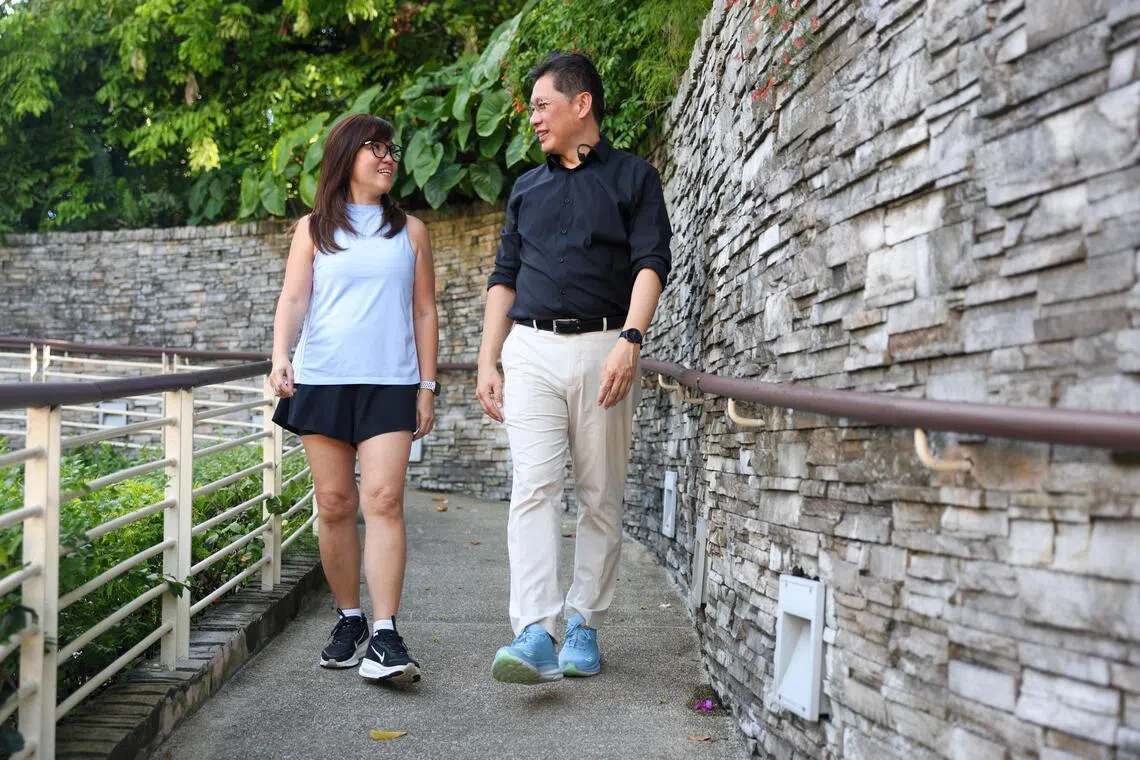
Mrs. Nancy Lim walks with surgeon Edward Chong, who removed a benign tumor in her chest.
ST Photo: Jasel Poe
2024 Madam Nancy Lim Muiluan, housewifeI found it difficult to breathe while singing in church. She consulted a general practitioner, who said her symptoms were part of aging and advised her to exercise more.
Thereafter, her weekly routine included at least three sessions of physical activity such as swimming and squash.doing Pilates Or a brisk walk. “During the surgery, my chest sometimes became clogged.” exercisebut it went away. “I didn’t feel any pain. I thought it was stress-related,” the 56-year-old man recalled.
In 2025, she found it unusually difficult to catch her breath while hiking in Melbourne.
General health examinations conducted as part of the national preventive health plan include: a healthier singaporeI saw a shadow inside her Chest X-ray examination. Further investigation identified a large leiomyoma, or benign tumor, in the esophagus. It was compressing her heart and lungs.
of youe and rare due to tumor location, say Dr. Edward Chong removed it through keyhole surgery in December 2025.
Damage to her esophagus was minimal, but Madam Lim was using a feeding tube until her organs recovered, and saliva and gastric juices had to be removed through another tube.
Dr. Chong insisted that Mrs. Lim do aerobic exercise, such as brisk walking, before and after the surgery. “Pre-rehabilitation before major surgery prepares the patient physically, medically and mentally,” says Senior Consultant Upper Gastrointestinal Surgeon at Pan Asia Surgery.
Before the surgery he texted she To periodically check if she walked. “I had to breathe, exhale and sweat, not just enjoy a nature walk,” she says.
Madam Lim worked with a yoga teacher friend to develop an exercise program that allows you to maintain or improve your fitness without getting injured.
She did some breathing exercises to calm her lungs before walking.
Her goal was to reach 50-70% of her maximum heart rate. based on her age. To avoid tension, she alternated between brisk walking and walking. normal walking.
She used the talk test while walking with friends. If she could carry on the conversation without gasping, she was walking at a reasonable pace.
She also relied on her smartwatch to track her pace and distance.
“Having this plan in place gave us something to work on in advance.” surgery. “What I could do for my health was within my control,” she says.
After surgery, Dr. Chung Walking around the hospital with Madam Lim, I encouraged her to continue exercising.
She now swims twice a week for 30 minutes with a break in between. She also takes a brisk walk for an hour three times a week.
She recently tried kettlebells and almost went overboard. “It hurt too much,” she says. “My body isn’t ready yet.”
she also avoids her previous sports, Squash thought it would be best to follow the doctor’s instructions: “Walk, walk, walk.”
“My daily brisk walk strengthened my lungs, strengthened my fighting spirit and gave me the resilience to bounce back after surgery,” she says. “I feel much better now.”

Weightlifter Chua Jing-Ling uses hearing aids to help her follow her coach’s instructions.
ST Photo: Azmi Atoni
Chua Jinglin, 27, a national weightlifter, has been wearing in-ear hearing aids since childhood.
She lost about 60 percent of her hearing by her first year of primary school due to a bout with Bell’s palsy from the age of two.
bell’s palsy It causes paralysis of the facial nerve and occurs in about 0.02% of the population, according to the national digital health platform HealthHub.
Her family only became aware of her hearing loss when she made mistakes such as hearing the name “Clement” as “Lemon”.
Chua started using a more discreet in-the-ear hearing aid. Her parents were worried that she would be treated differently or kept answering questions if her hearing aids were visible.
“Without hearing aids, I can hear sounds, but I can’t hear them clearly,” Chua says. “If you take it off when you sleep, no one will disturb you.”
She works as a revenue management analyst and trains three days a week after work, usually at the Singapore Weightlifting Federation’s space in Bedok.
She wears a hearing aid during training and Working with her coach. “You have to listen to the coach teach you technique and specific movements, so you have to listen to them explain it,” she says.
She also wears hearing aids. run Outdoors, for safety. “Sound is important. Sound is how we get information,” she says.
She says that using in-the-ear hearing aids has given her the confidence to try new sports and activities. She danced, swam, and competed in dragon boat races.
“If I didn’t have hearing aids, I wouldn’t have had the confidence to go out and try things,” she says. “If it weren’t for hearing aids, I probably wouldn’t be where I am today.”
#Exercise #harder #usual #worth