
I do calf exercises once a week at the end of my strength training. This involves standing up on the balls of your feet, lifting one leg off the ground, and slowly lowering the other leg. Sure, this is a good move to work your calves, but there’s more going on that makes this a powerful move for runners.
That said, this is a great example of an eccentric movement in that it focuses on the stretching (or lowering) aspect, which is very important for runners, especially long-distance runners. Mr. BuiDPT, CSCS, Level 1 USATF Certified Coach Perform restorative physical therapy.
“Eccentric training strengthens your muscles and tendons, making them more resistant to fatigue, more elastic, and stronger,” Bui says. “If you can prevent fatigue from occurring early in a race, you will waste less energy and therefore improve your endurance and running economy.”
It also helps prevent injuries. Many injuries typically occur during the eccentric phase of running, as muscles and tendons are loaded with at least three times your body weight when fully stretched.
Furthermore, in 2024 Systematic review of research Published in Frontiers in physiology We found that eccentric training significantly increases sprint speed and an athlete’s ability to change direction.
To reap these benefits, here’s a primer on what Bui calls the “most demanding” type of muscle contraction and how exactly to incorporate it into your daily life.
What does it mean to train eccentrically?
Before discussing eccentrics, Bui says it’s important to explain another type of muscle contraction: concentric. When you hold a dumbbell at your side and lift it up into a bicep curl, your biceps shorten against the load, which is a concentric movement, she says. “Then there’s isometrics, which means even if you’re just supporting your weight and your muscles aren’t shortening or lengthening at all, it’s still a type of load,” she added.
Finally, there are eccentric contractions. “Let’s say you’re holding a dumbbell at the top of a bicep curl, and you’re going to slowly lower that weight against the load, so the muscle stretches against the load,” says Bui. This is the eccentric contraction, which is typically the most demanding type of muscle contraction because it generates the highest mechanical tension in the muscles and tendons.
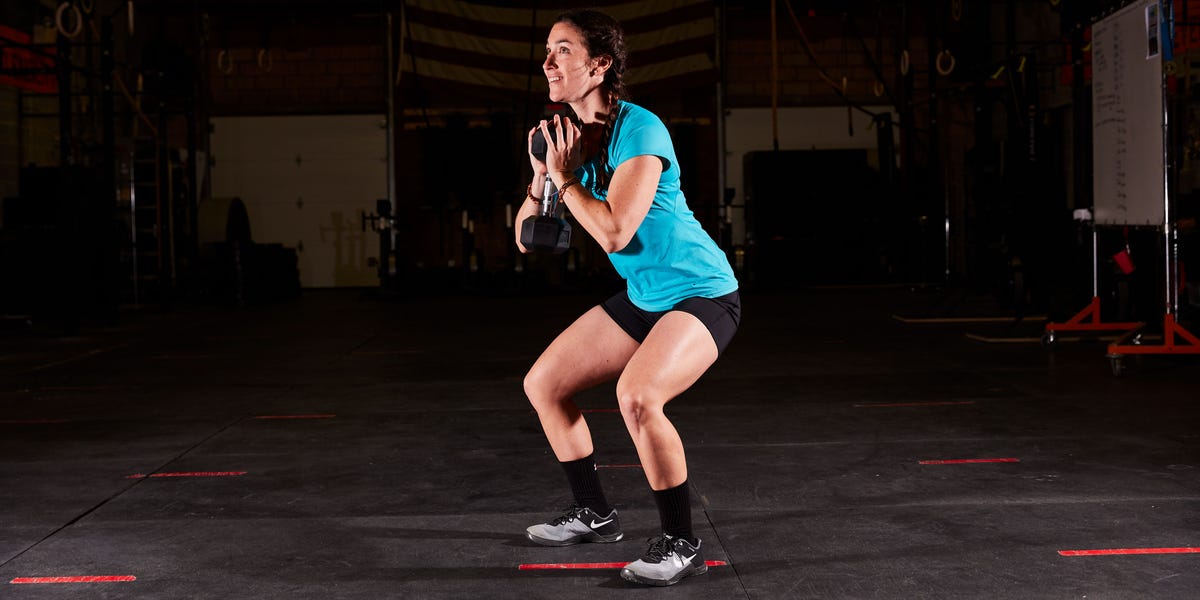
brad schoenfeldDr. CSCS, professor of exercise science at Lehman College in the Bronx, New York, adds this example: “Let’s say you’re doing a squat. When you lift your body up, you’re doing a concentric movement, and when you come down, you’re doing an eccentric movement,” he says, noting that both elements are inherent in almost every dynamic movement you do.
How does eccentric training affect running?
Both eccentric and concentric muscle contractions occur during running. According to Bui, during mid-stance (when all of your weight is on one leg) your quadriceps work eccentrically to control when your knee bends, and your calves work eccentrically to control when your ankle moves forward. As we move into the “toe-off” phase, the calves and hamstrings work concentrically, and then just before the foot hits the ground again, the hamstrings return to an eccentric role.
According to her, this abnormal movement is exaggerated when running downhill, which explains why the quadriceps, which act as abnormal brakes, become especially sore after hill runs or races.
Outlandish requests can become more of a burden as the execution progresses. “Especially in long races like half marathons and marathons, you’re more fatigued, and as a result, you’ll see poor form in your running gait,” she says. “If your form is compromised and unstable, you can be more prone to injury if your hips drop, your knees collapse, or your muscles fatigue and your ankles begin to pronate,” she says, which can lead to muscle strains and tendon injuries.
Indeed, in 2024 study A study from Germany involving 38 participants found that after a half marathon, both the quadriceps and hamstrings had a reduced ability to exert force during the eccentric phase, and that this effect was associated with a higher risk of injury, particularly around the knees. This is one reason why it’s wise to allow some recovery time before running again immediately after a long distance race.
In particular, Buoy sees a lot of hamstring strains (especially in sprinters, but also long distance runners). This usually occurs when the hamstrings are fully eccentrically extended during the late (end) swing phase of the stride if the hamstrings are not strong enough to withstand the load. Overstride further increases the risk.
How to incorporate quirkiness into your routine
The good news, Schoenfeld points out, is that if you’re doing dynamic exercises like squats or deadlifts, you’re already making eccentric muscle contractions. However, there are ways to emphasize some of the movements for even greater effect.
One way to do that, Bui says, is to simply slow down the descending phase of the movement. “Think about counting to five mid-squat, then move faster mid-squat,” she says. “This is actually very difficult for people to do, especially when doing it with bodyweight,” she says, but it’s best to start with three sets of 10 reps with bodyweight alone. Bui says slowing down has the added benefit of making balance and stability more difficult.
Once you are satisfied with the bilateral movements, move on to unilateral movements. “For many runners, incorporating eccentric single-leg exercises can be a very powerful tool,” Bui says. That’s because running itself is essentially a unilateral sport. That might be a single-leg squat (for quadriceps) or a single-leg Romanian deadlift (for hamstrings), doing the same 5-second count in the middle, she says.
Another strategy, Schoenfeld said, is called “maximally supra-eccentric,” which uses more weight for eccentric phases than for concentric phases. For example, use a leg extension machine to push up with both legs, release one leg, and lower just one leg. Basically, you’re putting twice as much weight on your legs on the descent.
You can also try wall squats, where you stand on both legs and lower on one leg. And of course, there’s the aforementioned calf raise example. Raise up to the balls of both feet, then slowly lower down with just one leg. Eccentric calf raises are especially effective for runners with a history of Achilles tendinopathy or calf strains, Bui says (though they should be avoided if you have active injuries in these areas).
There’s also something called flywheel training that can be effective, Schoenfeld said. can be found these machinesfor home use or some gyms, a handle is attached to the flywheel. “Energy is stored in the flywheel when pulling up, allowing for a more eccentric action when descending,” Schoenfeld explained, adding: the study I confirm this.
Finally, outside of the gym, Bui says downhill strides can also be helpful. “You can practice running fast downhill, but make sure you stay in control,” she says. “Stay tall, walk short and quick with your feet close to the bottom, and look 10 to 15 feet ahead.”
The important thing is not to overdo it. A way to incorporate eccentrics into your program, both experts say, is to choose one or two of the half-dozen movements you do on your strength day and focus on eccentrics. “If you try to do all of your circuit practice with eccentric intent, you’ll get very tired,” Bui says. She also recommends avoiding eccentric exercise on days you’ve done high-quality running training, such as intervals or long distance runs, as this will only make fatigue worse.
Ideally, sprinkling in a few quirky menu items before your next race will help keep you feeling fresh for longer.
#type #strength #training #important #prevent #muscle #fatigue #long #distance #runs