
Strength coach reveals how long you should hold a plank to prove elite core strength
Core strength tends to show up in moments when people aren’t thinking about it. We rely on it to carry groceries all at once, to walk for a while without shifting from side to side, and to get up from the floor without straining our hands. I’ve seen many busy, active adults in their 50s who begin to lose core strength and find that it takes more effort to perform the same movements and they lose their sense of stability. Hardly anything dramatic. It’s just gradually becoming more noticeable.
From a coaching perspective, those who move best over time usually have certain things in common. Their core allows them to stay engaged undiminished when things get tough. That ability is determined by strength and endurance working together, as the core must create tension and maintain it while the rest of the body moves around the core.
That’s exactly why the plank is so effective as a test. No equipment or complicated setup is required, and there is little room for shortcuts. Either maintain a strong position or start losing it. The amount of time a core can remain locked in provides a clear picture of how the core is actually performing. Let’s take a closer look at what it says and how to improve it.
What Planck can actually measure
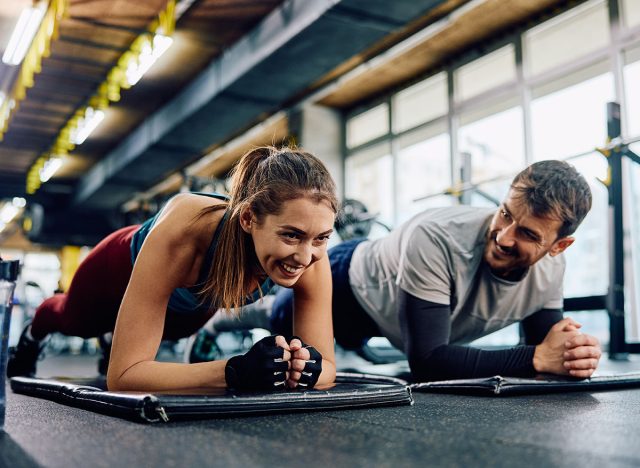
Planks train your core so that it can play its primary role in stabilizing your spine while everything else moves. The midsection of your body acts as a link between your upper and lower body, and the stronger that link, the more efficient and controlled your movements will feel.
Holding a plank also increases muscular endurance through isometric contractions. Muscles remain under constant tension without changing length. This is important because most real-world movements are not single efforts. It repeats and persists. Your core needs to work continuously, rather than firing once and relaxing.
It also gives you a feel for exactly where problems start to occur. Your hips may start to sag, your shoulders may shift forward, and your hips may try to move forward. These are all signs that your core is losing its ability to maintain its position. Being able to maintain a clean plank for an extended period of time shows that your core can stay focused, organized, and strong even as fatigue accumulates.
How to fix strong and clean boards
A good plank is determined by how well you can set it up. A small adjustment in position can make a big difference in the effect of the hold. When everything is stacked correctly, the tension is transferred to the core, not the joints.
manner:
- Place your forearms on the ground, with your elbows directly below your shoulders.
- Spread your feet about hip-width apart and extend your legs behind you.
- Tighten your core by tightening your midsection and pulling your ribs down.
- Squeeze your glutes and keep your hips level with your shoulders.
- Keep a straight line from your head through your hips to your heels.
- Maintain steady breathing as you hold the position until your form collapses.
Best variation: High plank, side plank, RKC plank, plank shoulder tap, stability ball plank.
The goal of plank time
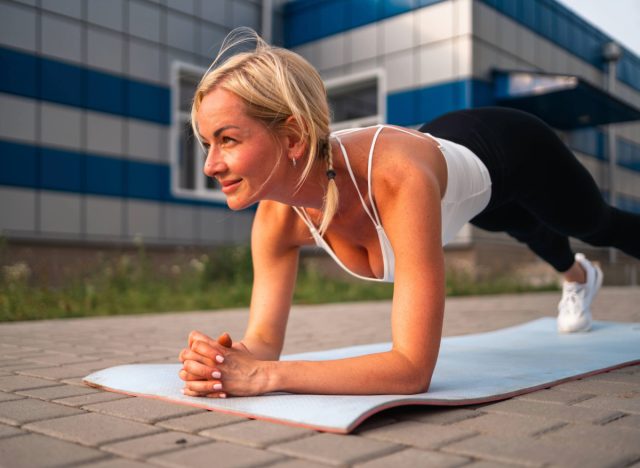
This test only works if the form remains clean. Once the position breaks, the set is complete.
- Less than 30 seconds: starting point
Your core is probably having a hard time maintaining tension for long periods of time. This is where capacity building begins. - 30-60 seconds: solid base
You have developed enough muscle strength to support most daily movements. - 60-90 seconds: stronger than others
The core exhibits excellent endurance and maintains proper posture even when fatigued. - 90 seconds or more: stronger than 90% of peers
This level shows strong control and staying power. Even when the hold becomes uncomfortable, your core maintains alignment, tension, and stability.
How to build a core that won’t weaken even after 55 years old
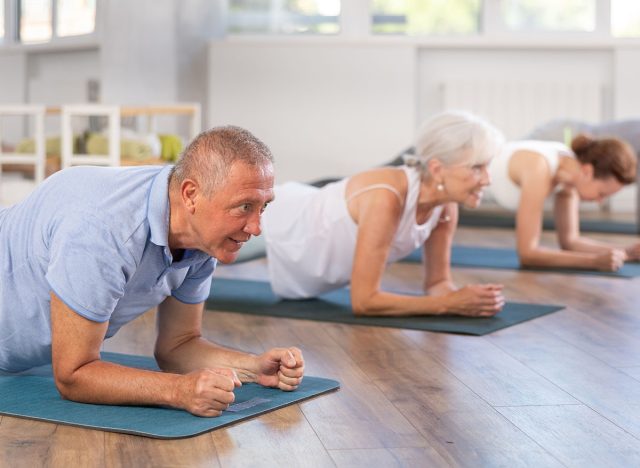
To improve your plank time, you need to develop the strength you can maintain. The goal is not just to survive the hold, but to continue to get stronger for longer.
- Train your core consistently. Build your endurance without becoming overly fatigued in 3-4 short sessions per week.
- Focus on tension throughout the body. Instead of holding every plank passively, treat it like strength training.
- Add exercises to counter the movement. Carries and Pallof presses strengthen core stability.
- Strengthens your glutes and hips. Control your pelvis and support a better plank position.
- Use short, high-quality sets. Multiple 20-40 second holds with great form are often more effective than one long, sloppy attempt.
- Pay attention to your breathing. Steady breathing helps maintain tension without burning out prematurely.
- Advance the time gradually: Keep the form fixed and add it little by little.
Core strength isn’t just about how long you can hold a plank, it’s also about how you move. If you can pass the 90 second mark with good form, you’ve built a level of strength that can support everything from everyday movements to more demanding activities.
References
- Bastos Carvajal, Juan Sebastian, Florencio Arias Coronel. “Exploring the role of the core in sports performance: A systematic review of the effects of core muscle training.” Frontiers in Sports and Active Living vol. 7 1630584. September 30, 2025, doi:10.3389/fspor.2025.1630584
- Amiri, Banafshe et al. “On the role of core exercises in reducing muscle fatigue caused by prolonged sitting: A scope review,” Sports Medicine – Open vol. 11,1 18. February 21, 2025, doi:10.1186/s40798-025-00816-x
- Oranczuk, Dustin J. et al. “Isometric training and long-term adaptation: The influence of muscle length, strength, and intention: A systematic review.” Scandinavian Journal of Medicine and Science in Sport Vol. 29,4 (2019): 484-503. doi:10.1111/sms.13375
Jarrod Knobbe, MA, CSCS
Jarrod Nobbe is a USAW National Coach, Sports Performance Coach, Personal Trainer, and Author who has been working in health and fitness for the past 12 years. Read more about Jarrod
#hold #plank #long #age #core #strength #stronger #peers